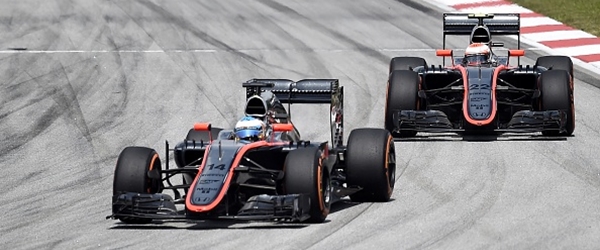
The furor that emanated after the less than inspiring Canadian Grand Prix came from the ‘issue’ of lift and coast, unless you find yourself unfortunate enough to be a World Champion behind the wheel of a mighty McLaren. So does everyone know what lift and coast is and why it has suddenly made its name as another issue for F1?
So, here are my five points to bear in mind when considering lift and coast in F1.
1
Lift and cost is not ‘coasting’. A driver cannot afford to just coast around a corner take it easy and miss the throttle point or compromise performance. It is in fact, under current legislation, the most efficient and effective way to finish a race in the quickest time, considering a car is not fuelled with enough fuel to finish a race, as a result of fuel weight. You will finish the race quicker if you lift and coast than if you were fuelled for the whole race.
2
Lift and coast is not new to driving and it certainly isn’t new to F1. Nico Rosberg has this week reminisced, ‘I remember my Dad doing it when he was racing with Alain Prost at McLaren…they had to save fuel because everybody was running out at the end of races’. The removal of re-fuelling in 2011 did not signal the start of fuel saving however it did rise to prominence as an issue at fuel limited race days. Has this ruined F1? Not for me. The races are still close, be that intra-team or throughout the field.
3
It’s a race – the winner gets to the end first. This seems to have been forgotten outside the paddock. You have to finish the race; if you don’t finish you have no chance. Cars have been under fuelled since the 2011 rule changes and the effect that lift and coast has on lap time is effectively in the realm of hundredths of a second per lift and coast lap. During a race each car will have to do this at some point because it is the quickest way to get to the chequered flag, which ultimately calls in to question how controversial an issue it really is.
4
It’s quite simply the fastest way to win. All a driver is doing is lifting off the accelerator around 50m before the natural breaking point. Assuming that a driver takes the corner correctly on the racing line and picks up the throttle at the right point, the effect of lifting and coasting is near enough zero. There are certain tracks where lift and coast has a bigger impact – as we saw in Montreal – however even in these extreme cases the most time sacrificed should not surpass three tenths of a second. Lifting and coasting efficiently comprises saving as much fuel as possible and sacrificing as little time as possible. Every driver has to fuel save and in so doing they save brakes and ensure that they reach the end of the race.
5
Lift and coast is not necessarily the easiest way to win, it is quite simply a skill and another aspect that people underestimate in F1. Would a driver like to fly at full throttle as they did in their early carting years – Yes, can they do this – No. Lift and coast compromises a driver’s natural instincts to race and go flat out. Drivers run the risk of missing carefully measured breaking points, locking up, taking the wrong lines and hitting the throttle too early or too late. They have to adjust their markers on entering and exiting a corner and this has made this technical aspect of driving an F1 car today far harder than it is to drive flat out. As each teammate does this, it is easy to forget that this has become a battle all of its own to see who is the most proficient at fuel saving.
For drivers like Fernando Alonso lift and coast will always have ruined F1, as have the tyres, the newly designed tracks and the hybrid engines – really its his ego and poor decision making that have cost him. He is undoubtedly extremely talented, nevertheless, only the drivers who challenge themselves and embrace the tenacity to master lift and coast will benefit in the future of F1.

 liveforf1